4th Alabama Infantry Regiment

Updated: Jun 1
Company B, The Tuskegee Zouaves
Army of Northern Virginia · 1861–1865
By: Col. Thomas Connell Date: June 1, 2026 Category: Civil War History, Civil War Reenacting

The 4th Alabama Infantry Regiment: An Overview
The 4th Alabama Infantry Regiment stands among the most widely campaigned Confederate infantry regiments of the Civil War. Organized in the spring of 1861 from volunteers drawn across the breadth of Alabama, from the mountain counties of the north to the fertile Black Belt of the south,¹ the regiment served from the opening weeks of the war through to Lee's surrender at Appomattox Court House in April 1865. Its service spanned all three major theaters of the conflict: the early coastal defenses of the Deep South, the long campaigns of the Eastern Theater under Robert E. Lee, and the bloody fighting of the Western Theater under James Longstreet. Few Confederate regiments can claim so broad and sustained a record of service.
Over the course of the war, the 4th Alabama enrolled a total of 1,422 men on its rolls. Of these, approximately 240 died in battle, nearly 100 died of disease, and 408 were discharged or transferred. The regiment surrendered 21 officers and 202 men at Appomattox, a fraction of the force that had marched so confidently to Virginia in the spring of 1861. By the autumn of 1862, after First Manassas, the Seven Days, Second Manassas, and Sharpsburg, the regiment had been reduced to a shell of its original strength, a pattern repeated across the Army of Northern Virginia. What remained was a veteran core of survivors, hardened by experience and bound together by years of shared hardship.
Organization and Recruitment
The regiment was organized at Dalton, Georgia, on May 2, 1861, drawing on volunteers from Conecuh, Dallas, Jackson, Lauderdale, Macon, Madison, Marengo, and Perry counties. Reflecting the early-war enthusiasm for military pageantry, the companies arrived bearing colorful self-styled names: the Governor's Guards, the Magnolia Cadets, the Canebrake Rifle Guards, the Conecuh Guards, the Huntsville Guards, the Marion Light Infantry, the Lauderdale Guards, the North Alabamians, the Larkinsville Guards, and Company B, the Tuskegee Zouaves.
The regiment's officer elections at Dalton resulted in Captain Egbert J. Jones of the Huntsville Guards was appointed Colonel, Captain Evander M. Law of the Tuskegee Zouaves was elected Lieutenant Colonel, and C. L. Scott was named Major. The regiment departed immediately for Virginia by rail, was mustered into Confederate service for one year at Camp Davis near Lynchburg on May 7, 1861, and proceeded to Harpers Ferry for training before falling back to Winchester, where it joined Brigadier General Barnard E. Bee's Third Brigade, a mixed force that also included the 2nd and 11th Mississippi, the 1st Tennessee, and the 6th North Carolina.

First Manassas and the Cost of Early Victory (July 1861)
The regiment's first great trial came at the First Battle of Manassas on July 21, 1861. The 4th Alabama committed approximately 750 men to the fight and sustained roughly 33 percent casualties, 38 killed and 208 wounded, in a single day. All three of the regiment's field officers were struck down: Colonel Jones was mortally wounded and died on September 3, 1861; Lieutenant Colonel Law was wounded; and Major Scott was also hit. General Bee himself was killed in the battle, in the same engagement in which he rallied his men by pointing toward Brigadier General Thomas Jackson's position on Henry House Hill and gave Jackson his enduring nickname.
"He will lead them anywhere, that the honor of battle can be plucked." Newspaper correspondent on Lt. Col. Evander M. Law, after First Manassas
Despite the losses, the regiment was celebrated by the Southern press for its tenacious resistance. Law recovered from his wound, returned to the regiment that autumn, and was elected Colonel of the 4th Alabama in October 1861, completing a rise from company captain to regimental commander in less than six months. The men named their winter encampment in his honor.
Reorganization and the Peninsula Campaign (1862)
The regiment's one-year enlistments expired in the spring of 1862. The 4th Alabama reorganized in April of that year, the men reenlisting for the duration of the war and re-electing their officers. At this point, the regiment was transferred to General W. H. C. Whiting's Brigade and moved to the Virginia Peninsula as part of the Confederate defense of Richmond against McClellan's Army of the Potomac.
The regiment fought at Seven Pines on May 31 and June 1, 1862, losing 8 killed and 19 wounded. During the Seven Days Battles that followed, it was heavily engaged at Gaines' Mill on June 27, where Law commanded Whiting's Brigade and the regiment suffered 130 men disabled. The performance drew praise from Stonewall Jackson's official report. The regiment also fought at Malvern Hill, where losses were comparatively light.
The Alabama Brigade: Second Manassas Through Sharpsburg (1862)
Rejoining the Army of Northern Virginia for John Pope's Northern Virginia Campaign, the regiment fought at Second Manassas in late August 1862, suffering 20 killed and 43 wounded. During the Maryland Campaign that followed, losses at Boonsboro were slight; at Sharpsburg on September 17, 1862, the bloodiest single day of the war, the regiment lost 8 killed and 43 wounded.
In October 1862, Law was promoted to Brigadier General and given command of what became known as the Alabama Brigade, eventually comprising the 4th, 15th, 44th, 47th, and 48th Alabama Infantry regiments. This consolidated all-Alabama brigade would be the regiment's tactical home for the remainder of the war, fighting under Law and later under Brigadier General William F. Perry. The regiment spent the winter of 1862 and 1863 at Dumfries before participating in a detachment with Longstreet at the Siege of Suffolk, Virginia, in the spring of 1863.

Gettysburg (July 2, 1863)
The regiment entered the Gettysburg Campaign in July 1863 with approximately 309 men under Lieutenant Colonel Lawrence H. Scruggs. Colonel Pinckney D. Bowles had been placed under arrest by Law for reasons that remain unclear in the historical record. On July 2, Law's Brigade attacked the Union left flank on the southern end of the battlefield. The 4th Alabama participated in the assault on Little Round Top alongside the 15th, 47th, and 48th Alabama and elements of the Texas Brigade. The regiment suffered 15 killed and 72 wounded and missing, roughly one-quarter of its engaged strength in a single afternoon's fighting.

Chickamauga and the Western Theater (1863)
In the fall of 1863, the regiment traveled west with Longstreet's Corps to reinforce Braxton Bragg's Army of Tennessee. At Chickamauga on September 19 and 20, 1863, the 4th Alabama lost 14 killed and 54 wounded out of approximately 300 engaged, again a casualty rate of roughly 33 percent, consistent with the regiment's characteristic pattern of hard fighting. The regiment moved next into East Tennessee, where it participated in the assault on Fort Sanders at Knoxville on November 29, 1863, sustaining 5 killed and 24 wounded before returning to the Army of Northern Virginia.
The Overland Campaign and the Siege of Petersburg, 1864 to 1865
Rejoining Lee's army in the spring of 1864, the regiment fought through the brutal Overland Campaign. At the Wilderness in May 1864, the 4th Alabama lost 15 killed and 58 wounded out of approximately 250 engaged, a rate exceeding 29 percent. At Spotsylvania Court House losses were 4 killed and 11 wounded. The regiment was engaged at Cold Harbor but suffered comparatively light casualties there.
From the summer of 1864 through the spring of 1865, the regiment endured nearly ten months in the trenches of Petersburg, the grinding siege warfare of the war's final phase, losing an additional 10 killed and 30 wounded. When Lee's army finally broke out of the siege lines and retreated westward in April 1865, the 4th Alabama marched with it, fighting to the end. The regiment surrendered with the Army of Northern Virginia at Appomattox Court House on April 9, 1865, under the brigade command of Brigadier General William F. Perry. It mustered 21 officers and 202 men at the surrender.
Coles, the regiment's adjutant and its principal historian, recorded the campaign with thoroughness and care in what was later published as From Huntsville to Appomattox, the primary regimental history and an essential source for any study of the 4th Alabama. Researchers seeking company-level detail beyond what the published history provides should also consult the Confederate regimental files and pension records held at the Alabama Department of Archives and History in Montgomery.
Company B: The Tuskegee Zouaves
Origins and the Zouave Tradition
Company B of the 4th Alabama Infantry was recruited in Macon County, Alabama, the county seat of which was Tuskegee, in the weeks immediately following Alabama's secession from the Union on January 11, 1861. The company was organized and initially commanded by Captain Evander McIver Law, a twenty-four-year-old South Carolina native and educator who had co-founded the Tuskegee Military School with Robert Parks in 1860.
The company bore the designation "Tuskegee Zouaves," a name that reflects the widespread antebellum fascination with the French North African light infantry units whose distinctive dress and aggressive fighting style had captured the American imagination. Zouave militia companies proliferated across the United States in the late 1850s, North and South alike, following the theatrical drill exhibitions of Elmer Ellsworth's U.S. Zouave Cadets. The name carried connotations of martial spirit, discipline, and dash that made it attractive to young men eager to distinguish their company from the ordinary run of militia.
The specific uniform worn by the enlisted men of the Tuskegee Zouaves is not documented in surviving sources. Contemporary accounts indicate that Captain Law himself wore a dark blue frock coat with four wide gold lace bars across the front, gold epaulets, and gold lace trim at the collar and cuffs, a distinctly martial appearance that borrowed from military fashion without conforming to a strict Zouave pattern. Whether the rank and file wore the traditional Zouave dress of baggy trousers, short embroidered jacket, sash, and fez remains unknown.
The company was composed substantially of Law's own students and of young men from the surrounding Macon County community, drawn from the plantation-class families that dominated the Alabama Black Belt(1) and their neighbors.
Early Service at Pensacola, January to February 1861
Before the company was mustered into the Confederate regular army, it had already seen active duty. On January 14, 1861, the Tuskegee Zouaves, then serving as part of the 2nd Alabama Volunteer Corps under Captain Law, were ordered south by rail to Pensacola, Florida. There, alongside the Wetumpka Light Guards, the Tuskegee Light Infantry, and the Metropolitan Guards, they participated in the seizure and occupation of Federal installations in the Pensacola harbor, including the navy yard and Fort Barrancas.
The company was stationed at Fort Barrancas for the better part of a month. Law wrote publicly of plans then being discussed to assault the U.S. garrison at Fort Pickens across the harbor, though the attack never materialized. The Alabamians returned home in mid-February 1861, tanned, celebrated, and newly experienced in field service. The deployment gave Law his first taste of independent command and the company its first experience of military mobilization under wartime conditions.
Mustering into the 4th Alabama
Following the fall of Fort Sumter and the formal outbreak of war in April 1861, the Tuskegee Zouaves were accepted into Confederate service at Tuskegee on April 28, 1861, under the command of Captain Law. At the regimental organization at Dalton, Georgia, on May 2, 1861, the company became Company B of the newly formed 4th Alabama Infantry. At that same meeting, Law was elected Lieutenant Colonel of the regiment, elevating him out of company command. Second Lieutenant T. B. Dryer was appointed Captain of Company B to fill the vacancy.
The regiment departed immediately for Virginia. The 4th Alabama was mustered into Confederate service for one year at Camp Davis, near Lynchburg, Virginia, on May 7, 1861, and proceeded to Harpers Ferry for training before joining Bee's Brigade at Winchester.
Under Fire: First Manassas and Captain Dryer's Wound
Captain Dryer led Company B into its first major battle at First Manassas on July 21, 1861. He was wounded in the left arm during the fighting, one of the 246 casualties the regiment sustained in the engagement. Despite the severity of the losses, Dryer continued in command through the early reorganization period.
Reorganization (1862)
When the regiment's one-year enlistments expired, the 4th Alabama reorganized in April 1862, with the men reenlisting for the duration of the war and re-electing their officers. Company B continued its service through this reorganization. The company's officers in the later years of the war included Captain E. J. Glass, who resigned his commission, and Captain Bayless E. Brown, who was killed at the Battle of the Wilderness in May 1864.
Company Officers

Legacy and the Long Road Home
The Cost of Service
The toll the 4th Alabama paid across four years of war was staggering. The regiment enrolled 1,422 men total; approximately 240 died in battle, nearly 100 died of disease, and 408 were discharged or transferred for wounds or other causes. Those who returned to Alabama in 1865 came home to a state devastated by the war, with fields untended, families broken, and an economy in ruins. Many of the men whose names appear on the muster rolls of Company B simply fade from the documentary record after the surrender, absorbed back into the life of Macon County.
Evander McIver Law, who had begun his military career as captain of the Tuskegee Zouaves and ended it as a Brigadier General, survived the war and returned to education. He organized the Alabama Grange in 1872, moved eventually to Florida, and in 1894 opened the Southern Florida Military Institute at Bartow, which was later absorbed into the institution that became the University of Florida. He died in 1920. Robert T. Coles, the regiment's adjutant, produced its most substantial history, the volume now known as From Huntsville to Appomattox, preserving the regimental record for future generations.
The 4th Alabama Reborn: The 167th Infantry in World War I
Alabama did not forget the 4th Infantry. In 1911 the Alabama legislature created a new 4th Alabama Infantry Regiment as part of the state's National Guard, a unit Alabamians regarded explicitly as the descendant of the Confederate regiment that had fought from Manassas to Appomattox. Mobilized in June 1916 for service on the Mexican border, the regiment trained at Vandiver Park in Montgomery under Major William Preston Screws.
When the United States entered the First World War in April 1917, the regiment was expanded to a full wartime strength of 3,720 officers and men. On August 14, 1917, the War Department redesignated the unit as the 167th United States Infantry Regiment. It was assigned to the 42nd "Rainbow" Division, so named because it drew on National Guard units from twenty-six states, and departed Montgomery on eight trains for Camp Mills on Long Island on August 28, 1917.

The 167th Alabama reached France in November 1917 and, after initial training with French units in the Lunéville sector of Lorraine, saw its first serious combat in the winter and spring of 1918. The regiment's defining moment came at the Battle of Croix Rouge Farm on July 26, 1918, where the Alabamians and their sister regiment, the 168th Iowa, led the Rainbow Division's assault in the Aisne-Marne Offensive. The fighting at Croix Rouge Farm cost the 167th 162 killed, including several company commanders, and more than 1,000 wounded. Their success forced the Germans to retreat, opening the road to a broader Allied advance.
The 167th went on to fight at St. Mihiel in September 1918 and in the Meuse-Argonne Offensive in October, where the 3rd Battalion bore the burden of the assault on the Côte de Châtillon, one of the most heavily fortified positions on the Hindenburg Line. Two members of the regiment, Corporal Sidney Manning and Private Thomas Neibaur, were recommended for the Congressional Medal of Honor for their actions in the campaign. The regiment entered Germany with the Army of Occupation before returning to Alabama in May 1919 to triumphal parades in Gadsden, Anniston, Birmingham, Montgomery, and Mobile.
The story of the 167th Alabama at Croix Rouge Farm is preserved and commemorated by the Croix Rouge Farm Memorial Foundation (croixrougefarm.org), which maintains a detailed regimental history, a complete roster of the regiment's members, and records of those buried in American Battle Monuments Commission cemeteries in France.
The Living History: Company B, 4th Alabama in New England
A Unit Rooted in Authenticity
For more than twenty-five years, the men and women of the 4th Alabama reenacting company have gathered as a family of living historians committed to honoring the memory of those who served in Company B of the 4th Alabama Infantry. The unit is one of the founding member companies of the Liberty Greys, a regiment-sized living history organization based in New England and organized as the 6th Regiment, 1st Division, Army of Northern Virginia. Together the Liberty Greys' ten member companies muster as a regiment at national events, while each company maintains its own individual historical identity.

The company was founded in the mid-1990s around the portrayal of the 4th Alabama Infantry, with Company B and the Tuskegee Zouaves as its particular historical focus. In the years that followed, the unit adopted the 15th Massachusetts Volunteer Infantry as its Union portrayal, and today the 15th Massachusetts has become the unit's primary regimental identity. Over more than two decades of active participation in reenactments and living history events across New England and beyond, the unit has built one of the largest and most stable rosters of any company in the region.
Galvanizing: The 15th Massachusetts Volunteer Infantry
The unit is the only company in New England that galvanizes as a unit, portraying both sides of the conflict rather than relying on individual members to cross over independently. While galvanizing is not uncommon in the national reenacting community, it remains genuinely rare in New England. The 15th Massachusetts Volunteer Infantry has grown into the unit's primary regimental identity. The 4th Alabama portrayal honors the regiment's origins and preserves the Confederate impression that has defined the unit since its founding, while the 15th Massachusetts reflects where the membership's deepest historical roots lie.
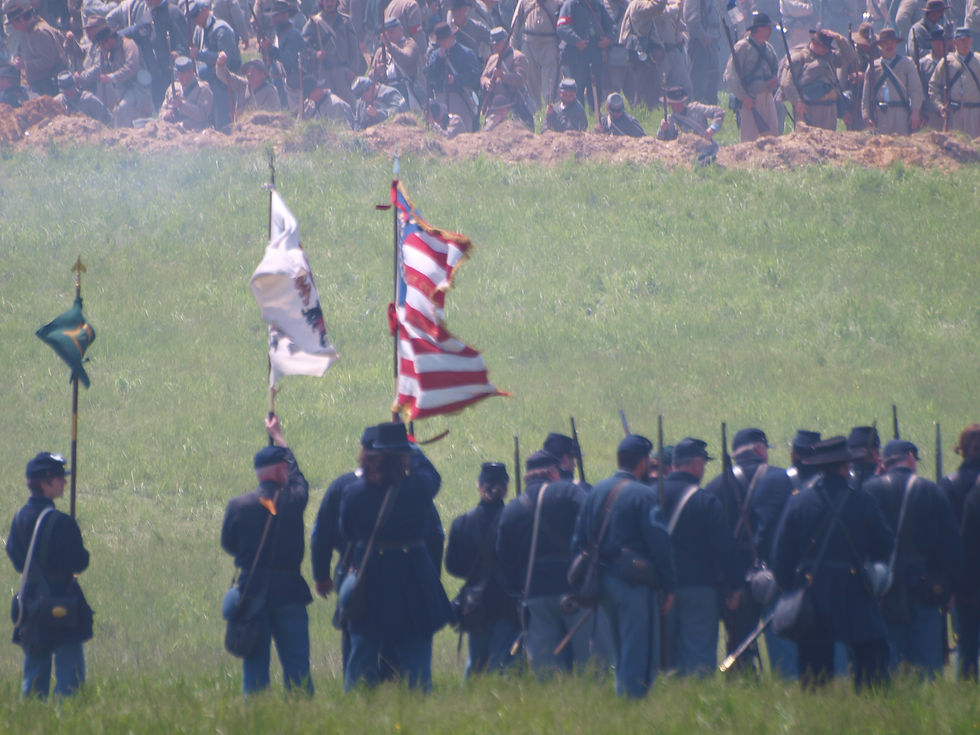
The 15th Massachusetts was mustered into Federal service in July 1861 and served throughout the war as part of the II Corps, Army of the Potomac, fighting at Ball's Bluff, Antietam, Fredericksburg, Gettysburg, the Wilderness, Spotsylvania, and the Siege of Petersburg. Composed predominantly of men from Worcester County, Massachusetts, the regiment suffered among the highest proportional fatality rates of any Federal infantry unit, losing 14 officers and 227 enlisted men killed or mortally wounded. For many members of the reenacting company, the connection to the 15th Massachusetts is not merely historical. Several members are direct descendants of Union veterans, and a number trace their lineage to soldiers of the 15th Massachusetts itself. The regiment's Honorary Colonel, Bob Ward, is the great-great-grandson of Colonel George Hull Ward, a Worcester, Massachusetts native who commanded the 15th Massachusetts until he was mortally wounded at Gettysburg on July 2, 1863. That living connection to the regiment's history gives the portrayal a personal dimension that goes well beyond the purely academic.
The unit holds active membership in both the Liberty Greys and its sister Union organization, the New England Brigade, and its members serve on boards and in advisory roles in both. That dual institutional presence reflects the unit's commitment to serving the living history community on both sides of the conflict, without partisanship and without compromise. Whether drilling in Confederate gray or Union blue, the members bring the same seriousness of purpose to their research, their impression, and their presentation on the field.
A Mainstream Organization with Range
The 4th Alabama / 15th Massachusetts company is best characterized as a mainstream reenacting organization, one that grounds its impression in authenticity and historical accuracy while remaining broadly accessible and welcoming to new members and families. The unit maintains rigorous standards for drill, camp life, and period-appropriate equipment and clothing, while ensuring that participation is practical and sustainable for members from a range of backgrounds.
Several unit members also participate individually in progressive and campaigner-style events, which demand a higher degree of material authenticity and a more immersive approach to the soldiering experience. The unit supports and encourages this, recognizing that different events call for different levels of presentation and that individual members' pursuits enrich the company's collective knowledge and depth.
Who We Are
The unit draws its membership from across New England, including Massachusetts, New Hampshire, Connecticut, and Rhode Island, and fields infantry, sharpshooters, field musicians, and a chaplain. Members range in age from fourteen to seventy-four. The company's retention rate is exceptionally high, a fact its members attribute to the culture of mutual support, the shared passion for history, the camp string band, and the campfire cooking that have defined the unit's character for a generation.
In keeping with documented historical practice, the unit welcomes women in its ranks, who honor the stories of the more than 400 women known to have served in disguise during the war, as well as the wives, daughters, and sisters who sustained armies on both sides through sacrifice and service. The unit also maintains a strong civilian component, with men, women, and children portraying camp followers and Southern families.

Officers and non-commissioned officers are elected annually by the membership, a practice that mirrors the electoral traditions of Civil War volunteer companies and gives every member the opportunity to lead and to follow. Family participation is central to the unit's identity; at times, three generations have stood together in the ranks.
"Whether we take the field as the 4th Alabama or the 15th Massachusetts, we do so with seriousness of purpose and a commitment to authenticity in drill, camp life, and historical interpretation."
The 4th Alabama / 15th Massachusetts company invites anyone with an interest in the Civil War era, the history, the material culture, the music, and the camp life, to explore what living history has to offer. The unit is part of the Liberty Greys at libertygreys.com.
Selected Sources and Further Reading
Primary regimental history:
Coles, Robert T. From Huntsville to Appomattox: R. T. Coles's History of the 4th Regiment, Alabama Volunteer Infantry, C.S.A., Army of Northern Virginia. Edited by Jeffrey D. Stocker. Knoxville: University of Tennessee Press, 1996.
Archival records:
Alabama Department of Archives and History. Confederate Regimental Files and Muster Rolls, 4th Alabama Infantry Regiment. Montgomery, Alabama.
Biographical sources:
Coddington, Ronald S. "The Little Gamecock: Evander M. Law." Military Images Magazine, June 2024. (With artifacts from the Craig and Carol Wofford Collection.)
Post-war and World War I legacy:
Croix Rouge Farm Memorial Foundation. "History of the 167th (Alabama) Infantry Regiment." croixrougefarm.org. [Covers the regiment's World War I service as the 167th U.S. Infantry, 42nd "Rainbow" Division.]
Secondary and reference sources:
National Park Service, Civil War Soldiers and Sailors Database, 4th Alabama Infantry Regiment. www.nps.gov.
Ohio State University eHistory. "Law's Brigade." ehistory.osu.edu. [Draws on Confederate Military History, vol. VII (Alabama).]
FirstBullRun.co.uk. Organizational records, movement orders, and muster data, 4th Alabama Infantry. www.firstbullrun.co.uk.
Emerging Civil War. "Yellowhammers and Environmentalism: Following the Path of Law's Alabama Brigade to Gettysburg (Part Two)." August 13, 2019. emergingcivilwar.com.
Osprey Publishing. The Confederate Army, 1861 to 1865 (2). Men-at-Arms series. [On the dress of the Tuskegee Zouaves and Captain Law's uniform.]
Wikipedia. "15th Massachusetts Infantry Regiment." [For the Union portrayal's basic organizational history.]
— END —
¹ The Alabama Black Belt is a 23-county region spanning the mid-section of the state. Originally named for its distinct, nutrient-rich dark soil, the region later became the heart of 19th-century cotton plantations and the 20th-century Civil Rights movement.


Comments